

How to Put On a Duvet Cover Without the Fight: Three Methods, and Why Yours Keeps Slipping
Canadian home guide, updated September 19, 2026
How to Put On a Duvet Cover Without the Fight: Three Methods, and Why Yours Keeps Slipping
The roll method that takes about a minute once you have done it twice, the inside-out method most people were taught, and the cover design that skips the technique entirely. Plus the two reasons a duvet bunches up inside its cover by the second night.



Short answer
How do you put on a duvet cover by yourself?
Quick answer: Use the roll method. Turn the cover inside out and lay it flat on the bed with the opening at the foot. Lay the duvet on top, corners matched. Starting at the head end, roll the cover and duvet together into one log down to the opening. Reach into the opening, grab the log through the cover from each side, flip the cover's edge over the ends of the log, then unroll it back up the bed. The duvet is now inside, corners already in place. Close the opening.
Why it beats the method you were taught: you never have to reach the far corners of a cover from inside it, and the duvet cannot bunch because it is rolled into position rather than pushed. It works alone, with a heavy winter duvet, and with a cover that has no corner ties. If you would rather not learn any technique, a cover that opens on three sides, like Hamuq's Easy Duvet Cover, lets you lay the duvet in flat and zip it shut. The three methods are compared below.
Why putting on a duvet cover is such a fight
Four things conspire against you, and most of them are the cover's fault rather than yours.
- The opening is at the wrong end. Most covers open at the foot, so to get the duvet's top corners into the cover's top corners you have to reach the full length of the bed from inside a fabric tube.
- The cover is bigger than the duvet. Covers are cut with a little ease so they go on at all, and on many brands the ease is generous. The gap is where the duvet migrates.
- The fabrics slide on each other. A cotton shell on a smooth duvet has nothing to grip, so the duvet moves every time you turn over.
- Nothing holds the corners. Corner ties and loops exist to fix this, but many duvets and covers have neither, and if only one of the pair has them they are useless.
The roll method solves the first problem completely and the second and third mostly. The fixes for slipping, further down, deal with the rest.
Method 1: the roll method (also called the burrito or California roll)
This is the one to learn. It takes longer to read than to do, and after two tries it takes about a minute.
- Turn the cover inside out and lay it flat on the bed with its opening at the foot of the bed. The inside of the cover is now facing up.
- Lay the duvet on top of it, matching the corners. If the duvet and cover both have ties or loops, tie them now; it is the only moment they are easy to reach.
- Roll from the head end. Starting at the closed top edge, roll the cover and duvet together into one tight log, all the way down to the opening at the foot. Keep the edges lined up as you go.
- Tuck the ends in. The opening of the cover is now wrapped around the end of the log. Reach into the opening on one side, take hold of the log, and pull the cover's edge over the end of it so the log's end is inside the cover. Do the same on the other side. If the cover has a zipper or buttons, this is where you close a few to hold it.
- Unroll. Roll the log back up toward the head of the bed. As it unrolls, the cover turns right side out around the duvet and the duvet arrives already in its corners.
- Close the opening and give the whole thing two shakes from the foot end to settle it.
The reason it works is that the duvet is never pushed into the cover; it is carried in, rolled up, with the corners fixed from the start. That is also why it works on a heavy winter duvet that would be exhausting to feed in by hand.
Method 2: the inside-out method
This is the method most people were shown, and it still works; it is just harder on a big bed.
- Turn the cover inside out. Put your arms inside it, all the way to the two top corners, and take hold of a corner in each hand from the inside.
- With the cover still on your arms, grab the two top corners of the duvet through the fabric.
- Lift and shake, so the cover falls down over your arms and onto the duvet, right side out.
- Match and tuck the bottom corners, then close the opening.
Where it goes wrong: on a queen or king cover you need a wingspan you probably do not have, so the top corners end up approximate, and the duvet bunches later. It also requires lifting the whole duvet at arm's length, which is why a heavy all-season duvet makes this method feel like a workout. Use it for a twin or a lightweight duvet; use the roll method for everything else.
Method 3: a cover that opens on three sides
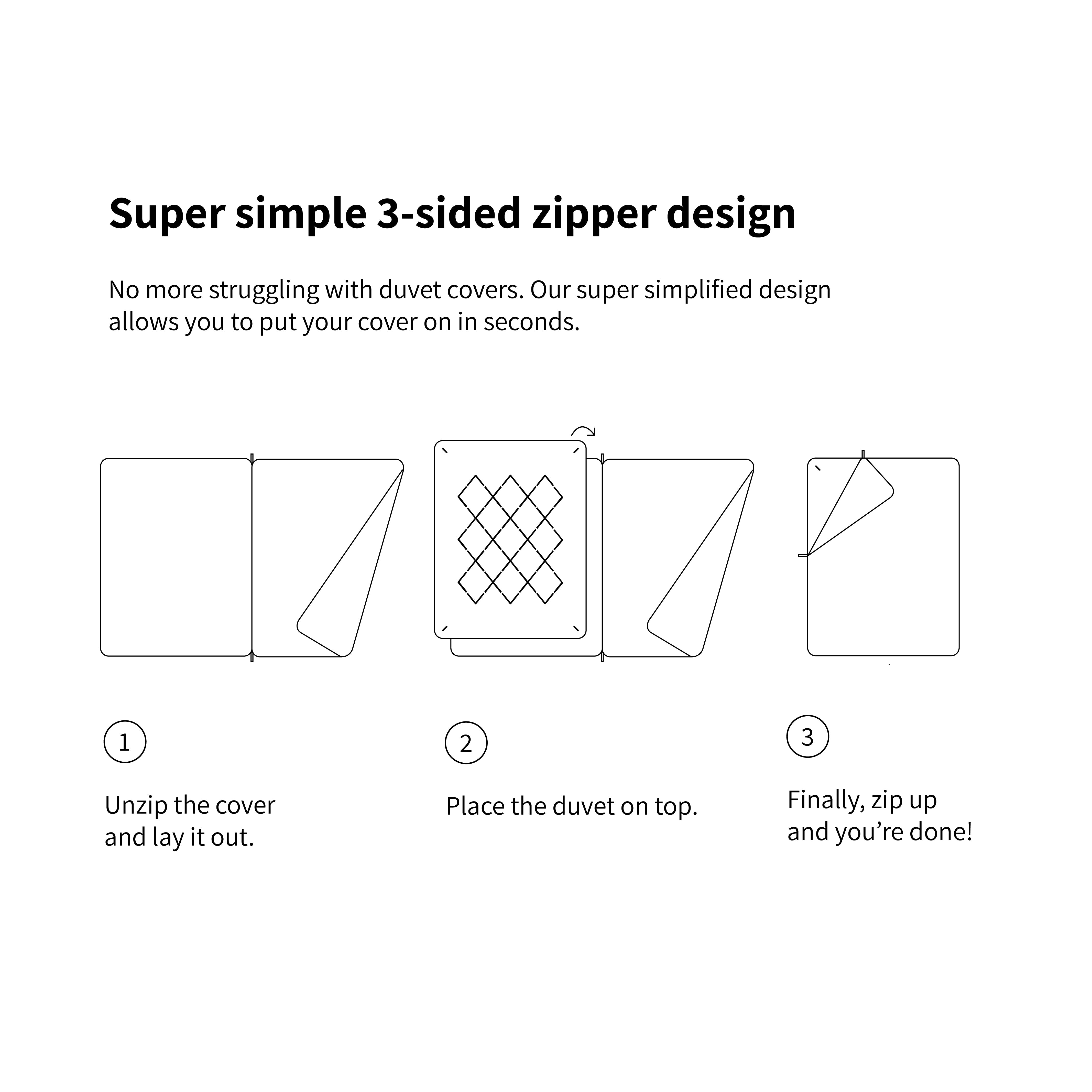
The third option is to stop fighting the design. A cover that zips along three sides opens up like a folder: you lay the duvet flat on the open cover, match the corners with everything in plain view, fold the top over, and zip it shut. There is no technique to learn and no reaching into a tube.
Hamuq's Easy Duvet Cover is built this way. Hamuq's own description of it is three steps: open the cover, place the duvet, zip up the cover. As read on September 19, 2026 it is $160 in Twin and $170 in Full; the Queen ($180) and King ($200) sizes were showing as sold out that day, so check the page for current stock before planning around it. Hamuq's own duvet size guide describes the cover and its Down Duvet as a matched pair, cut for each other size for size, which matters for the slipping problem covered below.
The trade-off is that a three-sided zipper is a specific design, so if you already own covers you like, the roll method gets you most of the benefit for free.
The three methods compared
| Method | Time once learned | One person, queen or king | Heavy winter duvet | Needs corner ties | Needs a special cover |
|---|---|---|---|---|---|
| Roll (burrito) | About a minute | Yes | Yes | No, though ties help it stay put | No |
| Inside-out | Two to three minutes, plus retries | Awkward on a king | Tiring | No | No |
| Three-sided zipper | Under a minute | Yes | Yes | No | Yes |
Why the duvet slips and bunches inside the cover, and the fixes
Getting the cover on is half the problem. By the second night the duvet has often slid to one side or scrunched into the bottom third. Two causes account for most of it.
Cause 1: the cover is bigger than the insert
If a queen cover is cut two to four inches larger than the queen duvet inside it, the duvet has that much room to wander every time you turn over. Duvet and cover dimensions vary by brand under the same size label, so "queen" on both tags does not guarantee a match. Measure both and compare; our guide to duvet sizes in Canada has the typical dimensions and a chart. If your cover is noticeably larger, the fixes below help, but a properly matched pair is the real cure. Hamuq's duvet size guide describes its Down Duvet and Easy Duvet Cover as a matched pair, cut for each other size for size.
Cause 2: nothing is holding the corners
Corner ties on the cover and loops on the duvet keep the corners where you put them. If your pair has them, use them; the roll method's step two is the easy moment to tie them. If only one has them, or neither does:
- Duvet clips. Small plastic or fabric clips that grip the duvet corner through the cover from the inside. Inexpensive and effective; the fabric-covered ones are gentler on a cotton shell.
- Safety pins at the four corners, from the inside so nothing shows. Crude, but it works and costs nothing.
- Sew on ties. Four short lengths of twill tape stitched inside the cover corners, and four loops on the duvet corners, is a twenty-minute job that fixes it permanently.
Two smaller causes
A very smooth duvet shell slides more than a textured one, and a lightweight duvet slides more than a heavy one because it has less inertia. Neither is worth replacing a duvet over, but they explain why the same cover behaves differently with a summer and a winter insert.
Keeping it in place through a Canadian winter
Whether you run two duvet weights, a lighter one for summer and a heavier one for the cold months, or one all-season duvet all year, the seasonal swap is the moment to do everything above properly: match the corners, use the ties, and shake the whole thing from the foot end so the fill settles evenly. Our guide to winterizing your bed covers the rest of the seasonal changeover.
If you are choosing a duvet as well as a cover, Hamuq's Down Duvet is sold in two fills: All Season and Lightweight. Hamuq's product page lists it as North American 650 loft white down in a 300 thread count, 100% cotton shell, with the All Season fill at 25 oz and the Lightweight at 19 oz. As read on September 19, 2026 it is $279 in Twin, $299 in Full, $349 in Queen and $399 in King; the King All Season was showing as sold out that day. If you tend to wake up hot, the Lightweight fill is the one to look at first.
One more thing while the bed is stripped: it is the easy moment to check the mattress protector underneath and to give the mattress itself a clean before the winter bedding goes on.
Questions people ask
Duvet cover FAQs
How do you put on a duvet cover by yourself?
Quick answer: Use the roll method. Lay the cover inside out with the opening at the foot, lay the duvet on top with corners matched, roll both together from the head end into a log, tuck the cover's opening over each end of the log, then unroll it back up the bed. The duvet ends up inside with the corners in place, and it works alone on any size bed.
What is the burrito method for a duvet cover?
Quick answer: Two names for the same thing. The burrito method, sometimes called the California roll, is the roll method described above; the name comes from rolling the cover and duvet together into a log before unrolling it onto the bed.
Why does my duvet slide around inside the cover?
Quick answer: Usually because the cover is cut larger than the duvet, which gives it room to move, or because nothing is holding the corners. Match the measured dimensions of cover and insert, and use corner ties, duvet clips or safety pins at the four corners from the inside.
Should a duvet cover be bigger than the duvet?
Quick answer: Only slightly. A little ease is needed to get it on, but a cover several inches larger than the insert is the main cause of bunching. Measure both; sizes vary by brand under the same label, and a pair sold as a match, like Hamuq's Down Duvet and Easy Duvet Cover, is the simplest fix.
What is a three-sided zipper duvet cover?
Quick answer: A cover with a zipper running along three edges so it opens flat like a folder. You lay the duvet in with the corners in plain view, fold the top over and zip it closed, with no reaching inside a tube. Hamuq's Easy Duvet Cover is this design; as of September 19, 2026 it is $160 in Twin and $170 in Full, with Queen and King showing as sold out that day.
Do I need corner ties on a duvet cover?
Quick answer: Not to put it on; the roll method works without them. They help it stay put afterwards, but they only work if the duvet has matching loops. If one or both are missing, duvet clips or four safety pins from the inside do the same job.
How we know this
This guide was built on September 19, 2026. The three methods are household technique, described from doing them on a queen bed; the times in the comparison table are what we observed, not a measured study, and no survey or statistic is claimed. The size-mismatch explanation draws on our own Canadian duvet size guide, which gives typical dimensions by size and notes that they vary by brand. All Hamuq details, including the Easy Duvet Cover's three-sided zipper design and three-step description, its prices and the sizes showing as sold out, and the Down Duvet's fill, loft, thread count, shell, fill weights and prices, were read from Hamuq's product pages on the same day and are quoted in their wording. The statement that the cover and the Down Duvet are sold as a matched pair comes from Hamuq's own duvet size guide, linked above, not from the product pages. No competitor product is named, and no review counts or star ratings are cited.
Or skip the technique altogether
The Easy Duvet Cover zips along three sides: open it, lay the duvet in, zip it shut. It is $160 in Twin and $170 in Full as of September 19, 2026, with Queen and King showing as sold out that day. Hamuq sells it as the match for its Down Duvet, which is $349 in Queen in either the All Season or Lightweight fill. Both ship free across Canada, with possible extra charges to the Canadian Territories.
About the authors
Jordan BedwellCo-founder of Hamuq. Product details in this guide are quoted from Hamuq's own product pages as read on September 19, 2026.
Mark Edcel LopezGathered the questions Canadians ask search engines about duvet covers, compared the three methods, and wrote the answer-first structure.
Nathan NielsonCo-founder of Hamuq. He is not designated as a product reviewer for this guide.
Hamuq Inc. sells the three-sided zipper cover and the duvet mentioned here, which is why the roll method is given first and in full: it works with any cover you already own, and the comparison table says so.